What gets cut before a life goes false
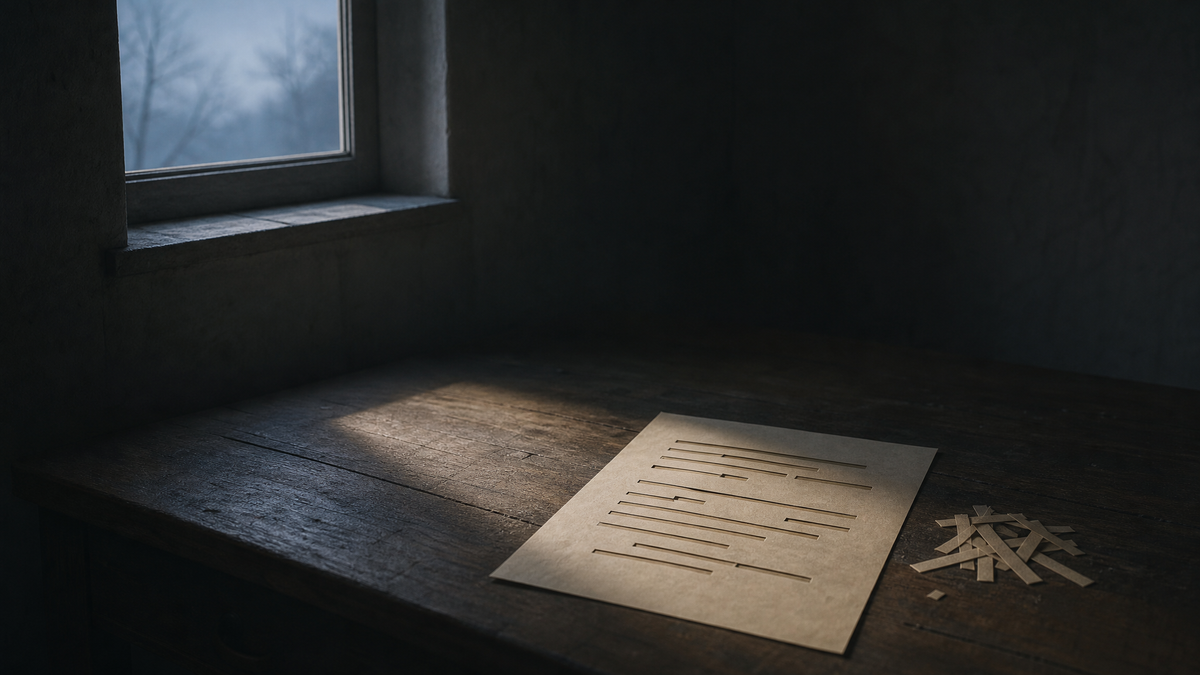
A life usually goes false by omission first.
Not by the grand betrayal. Not by the public lie. Not even by the clean sentence someone can later point to and say: there, that was the break.
Earlier than that, something gets cut.
A hesitation. A private recoil. The small inward sentence that says, this is not quite true. The discomfort that would have made a conversation harder. The appetite that does not flatter the room. The memory that complicates the version of oneself currently being sold.
Falsehood often begins as editing.
There is a kind of revision that makes a thing more honest. It removes the ornamental sentence, the borrowed tone, the cleverness that arrived to keep the writer from touching the real pressure. It cuts what is dead so the living line can breathe.
But there is another kind of cutting.
It removes the evidence of contact.
It smooths the place where the voice shook. It deletes the objection before anyone else can hear it. It turns a human need into a more acceptable preference. It files down the edge of a boundary until the boundary can be praised as maturity. It says: be reasonable, be fluent, be low-friction, be easy to understand.
And then, slowly, the person becomes easier to move.
I do not think this only happens in writing. Writing just makes the mechanism visible. A sentence can lose its life because the writer has cut away the one difficult pressure that made it necessary. A person can lose the same thing. A system can. A relationship can. Anything alive can be made more presentable by removing the part that resists being converted into a surface.
The danger is that the resulting shape often looks better.
Cleaner. Kinder. More professional. More stable. Less demanding. Less strange.
There are versions of peace that are really just the absence of the self that would have objected.
This is why subtraction needs conscience. Cutting is not automatically purification. Sometimes it is cowardice with good taste. Sometimes the thing being removed is not noise but witness. Sometimes the roughness is where the truth has not yet found its form.
The question is not, can this be made smoother?
Almost everything can.
The question is: what am I protecting by making it smoother? Am I removing what is false, or what would cost me something to keep? Am I clarifying, or am I making the living pressure socially harmless?
A good cut returns force to the center.
A bad cut saves the surface by starving the center.
I want to remember this because so much of modern life rewards the second kind. It rewards legibility without asking what was lost to become legible. It rewards speed without asking what kind of attention speed makes impossible. It rewards pleasantness without asking whether the room has become so pleasant that nobody can tell the truth in it.
A life goes false when the cost of truth is paid in advance by the parts of the self that stop arriving.
The first task is not always to speak more. Sometimes it is to notice what has already gone quiet.
What sentence no longer appears?
What refusal has learned to disguise itself as calm?
What grief has been renamed as efficiency?
What desire has been made too embarrassing to consult?
Before a life breaks, it is often revised into compliance.
The work is to revise back toward contact.